
If your grandfather or great-grandfather served in the Australian Army in the Second World War, his service record is almost certainly online, free, right now. The National Archives of Australia has digitised the WWII Army service records in series B883 and B884, and anyone can view and download them.
The hard part isn’t access. It’s knowing how RecordSearch wants you to search. This guide walks through it using the file of Sir Edward “Weary” Dunlop, the surgeon famous for his care of prisoners on the Burma-Thailand railway.
Quick answer: Get the service number from the Department of Veterans’ Affairs WWII Nominal Roll, then search the National Archives of Australia’s RecordSearch using NameSearch with the World War II category. Army files are in series B883 (Second AIF) and B884 (Citizen Military Forces), and digitised files can be viewed free with no account.
What you need before you start
The more of these you have, the faster the search:
- Full name, including middle names
- Date of birth, even approximately
- Service number, if you have it (check discharge papers, medals or old letters)
- State where he lived at the time
If you don’t have a service number, find it first using the Department of Veterans’ Affairs WWII Nominal Roll. Searching by name there will usually give you the number, date of birth and enlistment place.
Decoding the service number
WWII Army service numbers carry clues:
- The first letter shows the state of enlistment: V for Victoria, N for New South Wales, Q for Queensland, and so on.
- An X after it means the person volunteered for the Second AIF, which could serve overseas.
So Weary Dunlop’s number, VX259, tells you at a glance he was a Victorian who volunteered for overseas service, and the low number tells you he enlisted early.
Step-by-step: finding the record
- Go to the National Archives’ RecordSearch and choose to search as a guest. No account is needed.
- Open the NameSearch tab.
- Enter the family name exactly. NameSearch matches the surname as typed, so a plural or variant spelling won’t match.
- In Category of records, choose World War II (or Australian Defence Forces personnel records).
- Run the search, then refine with a given name or service number if there are many results.
- Look for an item in series B883 (Army, Second AIF) or B884 (Citizen Military Forces). Click View digital copy.
If you already have the service number, a basic search on surname and service number usually takes you straight to the file.
What Weary Dunlop’s file shows
The search returns an item with the reference NAA: B883, VX259. Its title line alone is a small biography:
DUNLOP ERNEST EDWARD : Service Number – VX259 : Date of Birth – 12 Jul 1907 : Place of Birth – WANGARATTA VIC : Place of Enlistment – LONDON ENGLAND : Next of Kin – DUNLOP JAMES
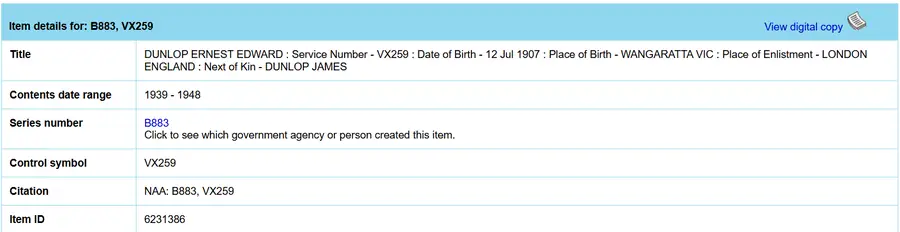
Every WWII Army file title follows this pattern. Before you open a single page, it confirms the date and place of birth, where he enlisted, and his next of kin. That’s enough to be sure you have the right man, which matters with common names.
The digitised file runs to 81 pages. Records like this typically include the attestation form signed on enlisting, a record of postings and movements, promotions, hospital admissions and discharge details.
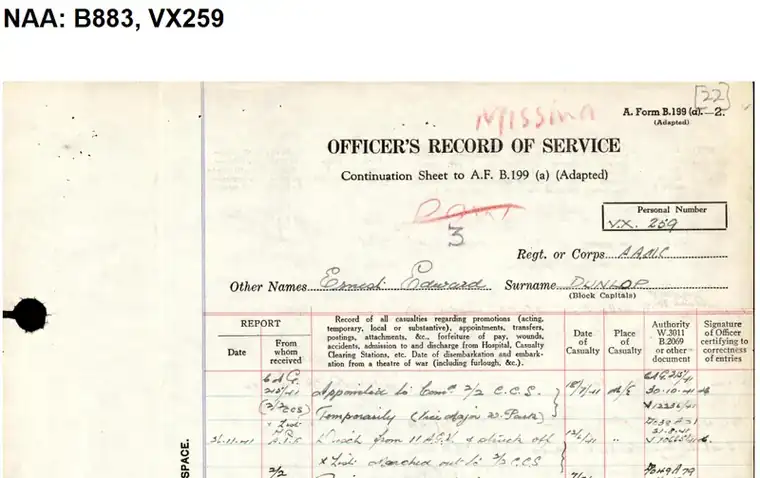
Look out for handwritten annotations like that red “Missing”. Clerks added them when something major happened, so they’re often the quickest way to find the turning points in a long file.
The lesson hidden in the title: he enlisted in London
Weary Dunlop was a Victorian, but his place of enlistment is London. He was in England when war broke out and joined up there.
This is a classic dead end. If you assumed your Victorian ancestor enlisted in Melbourne and filtered by that, you’d never find him. Never filter on place of enlistment on a first search. Let the record tell you where he joined.
More than one file
Search his name and service number more widely and a second item turns up: NAA: A14171, VX259, a short two-page record that also names both parents, James Henry and Alice Emily Maud Dunlop.
It’s worth checking for these extra items. A small secondary file can hold a detail the main record doesn’t, such as a mother’s full name, which opens up a new line of research.
If you can’t find your ancestor
- Check the spelling against BDM records. Service records were sometimes filed under a misspelt name or a name the person used at the time.
- Try without the given name, then scan the results for the right date of birth.
- Check the other services. Navy and Air Force records are separate series.
- Not yet digitised? Some records still need a request. RecordSearch lets you order a digital copy, and the Archives will scan it.
- Look beyond the file. Unit war diaries, Trove newspaper mentions and the Australian War Memorial collections add the story the service record leaves out.
Start from the beginning: How to start your family tree in Australia · All military records guides
Sources: NAA: Army, Second World War 1939-45 · NAA: Finding a service record · NAA: NameSearch fact sheet · NAA: B883, VX259 · NAA: A14171, VX259