
Queensland’s Registry of Births, Deaths and Marriages runs the Queensland BDM search, one of the best free family history searches in the country. You can search by a person’s name, by their parents’ names, or by both, and buy a scan of the original register entry online, with no proof of ID.
This guide shows how to use it, what the registration number means, and how to get the most out of a single result, using the birth of Steele Rudd, the author of On Our Selection.
Quick answer: Search the free Queensland family history index at familyhistory.bdm.qld.gov.au. It covers births more than 100 years ago, marriages more than 75 years ago and deaths more than 30 years ago. Search with as few details as possible, try a search on the parents’ names alone, and buy the historical image (the cheaper option) rather than the certificate: it shows the same entry for less.
What the Queensland BDM search covers
- Births from 1829 to 100 years ago.
- Marriages from 1829 to 75 years ago.
- Deaths from 1829 to 30 years ago.
- Church records before 1856: baptisms, marriages and burials transcribed from church registers, since civil registration only began in 1856.
- Some special records: births and deaths at sea on voyages to Queensland, and deaths of servicemen who enlisted in Queensland and died in the two world wars.
A new year of records is released each January. Queensland was part of New South Wales until December 1859, so for events before then it’s worth searching the NSW index too.
Step-by-step: running the Queensland BDM search
- Go to the Queensland Government’s family history research service. Searching is free, with no account needed.
- Choose births, deaths or marriages.
- Enter the surname and first given name only. Leave middle names out.
- Add a date range if the name is common, but make it wide.
- Read the results. Each one shows the date, the parents’ names for a birth, and a registration number.
- Before a new search, click Clear. Old search terms can stay hidden in the form and quietly narrow your next search.
The worked example: Steele Rudd
Steele Rudd was the pen name of Arthur Hoey Davis, born on 14 November 1868 at Drayton, near Toowoomba. Search the births for surname Davis, given name Arthur, and his entry comes up like this:
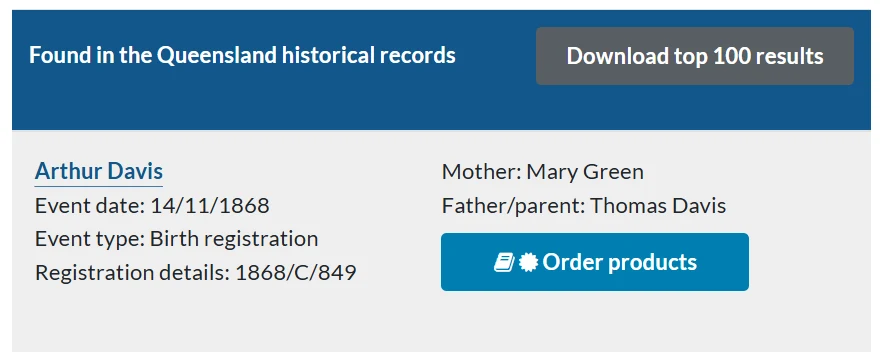
Here’s what this one entry tells you:
- He’s not “Steele Rudd” here, or even “Arthur Hoey”. The index has him as plain Arthur Davis. The famous name is a pen name he took up in his twenties, and the middle name isn’t in the index entry. Searching the name he’s known by would miss him completely. The name changes guide covers this in detail.
- The parents are named. Thomas Davis and Mary Green. A Queensland birth index gives you the mother’s maiden name, which is your key to the parents’ marriage and to the rest of the family.
- The registration number is 1868/C/849. Registered in 1868, outside Brisbane (“C” for country), the 849th such registration that year. That’s the number you need to order the record.
- The date is the date of birth, which matches his biography exactly. That’s good confirmation you have the right person.
Taking it further
One birth entry opens up the whole family. Search the births again with no child’s name at all, just the father Thomas Davis and the mother Mary Green, and a wide date range. Queensland’s index lets you search by parents alone, which brings up the brothers and sisters together, including children who died young and daughters who later married and changed their surname. Thomas and Mary had thirteen children; Arthur was the eighth.
The family’s backstory points to two more record sets. Thomas Davis was a Welsh blacksmith who reached Australia in 1847 after a conviction for petty theft, a job for the convict records guide. Mary Green came out from Ireland in 1848 under a scheme that brought orphan girls from Irish workhouses, which is covered in how to find when your ancestor arrived. They married in 1852, before civil registration began, so look for the marriage among the church marriages in the index, and in NSW records if it doesn’t turn up.
What the registration number means
Every Queensland registration number has three parts: the year it was registered, a letter code, and a number. The codes worth knowing:
- B: registered in Brisbane.
- C (or no letter): registered outside Brisbane. “Brisbane” meant only the inner city until the councils merged in 1925, so a birth in a suburb like Windsor in 1880 is a “C”.
- M: a birth or death at sea, registered at the first Queensland port.
- O or R: a birth registered more than 60 days late. The year of registration may be later than the year of birth.
- BBP: a church baptism from 1829 to 1855, not a civil birth registration.
- A number starting 1854 for an event before 1856: the year in the number isn’t the year of the event.
Image or certificate: which to buy
- Historical image: a scan of the register entry, downloaded straight away. This is the one to buy.
- Source image: for some events there’s also a scan of the original form filled in at the time, often in the informant’s own handwriting. It can include details left out of the register. It isn’t available for every event.
- Historical certificate: a typed transcription posted to you. It costs more, takes longer, and every transcription can introduce errors.
Fees change, so check the current price on the Queensland Government page before you order. Log in with a Queensland Digital Identity account before you pay, so your downloads are saved to your account; otherwise download the image immediately from the receipt page.
If you can’t find them in the Queensland BDM search
- Search by the parents only. It finds children whose own names were misspelt or changed.
- Drop the middle name and try just the first initial, or only the surname with a date range.
- Try spelling variants: Davis and Davies, Reilly and Riley.
- Widen the dates. Late registrations can be filed years after the event.
- Check the NSW index for anything before 1860.
- Check the access periods. A birth from 1930 won’t be in the index yet, however you search.
Frequently asked questions
Yes. Searching the historical index is free and needs no account. You only pay if you buy an image of the register entry or a certificate.
Births from 1829 to 100 years ago, marriages from 1829 to 75 years ago, and deaths from 1829 to 30 years ago. Records before 1856 are mostly church baptisms, marriages and burials.
It means the event was registered outside Brisbane. B means Brisbane. Because Brisbane’s boundaries were much smaller before 1925, many events in what are now suburbs carry a C.
The historical image. It is a scan of the original register entry, costs less, and downloads straight away. A certificate is a typed transcription, costs more, and can contain transcription errors.
Get new guides by email
Get the free 9-step brick wall checklist, plus a new Australian family history guide in your inbox whenever one is published. No spam, unsubscribe any time.
Related: How to search NSW BDM for free · How to search Victorian BDM for free · All Births, Deaths & Marriages guides
Sources: Queensland Government: How to order historical records · Queensland Government: Research codes · Australian Dictionary of Biography: Arthur Hoey Davis · UQ Fryer Library: Steele Rudd
Stuck on a name or a record? Tell me what you’ve already tried in the comments and I’ll point you to the next search.