
The Victorian BDM search, run by Births, Deaths and Marriages Victoria, is a free historical index that goes back to 1836. It’s quick, needs no account, and for most Victorian families it’s the first place to look.
It also has limits that catch people out, and the biggest one has nothing to do with the search box: Victorians didn’t stay in Victoria. This guide walks through it using Dame Nellie Melba, who was born in Melbourne, married in Brisbane and died in Sydney.
Quick answer: Use the free historical index on the Births, Deaths and Marriages Victoria website. It covers births more than 100 years ago, marriages more than 60 years ago and deaths more than 30 years ago, from 1853, plus church records from 1836 to 1853. Search with a date range, and if an event is missing, check the other states’ indexes.
What the free Victorian BDM search covers
- Births: 1853 to 100 years before today
- Marriages: 1853 to 60 years before today
- Deaths: 1853 to 30 years before today
- Church baptisms, marriages and burials: 1836 to 1853, before civil registration began
- Events at sea: births, deaths and marriages on ships bound for Victoria, 1853 to 1920
Records become searchable on the day they pass the limit. Note that Victoria allows marriages after 60 years, where NSW waits 50, so the same couple’s marriage can appear in one state’s index years before the other.
What a Victorian BDM search result tells you
Each entry gives the person’s family and given names and the type of event. For a birth, it adds the mother’s given names and her family name at birth, the father’s given names, and the place of birth. For a death, it can add the place of death, the spouse and the age at death. Every entry ends with the registration year and number.
The mother’s maiden name is the prize. It confirms you have the right person, and it gives you the surname to search for her own birth and her parents’ marriage, the next generation back.
The index is a summary. The full certificate can add much more: for a birth, the parents’ ages and birthplaces, their marriage details and the children born before; for a death, the cause of death, place of burial, birthplace and parents’ names. Certificates and images cost a fee from the Registry.
Step-by-step: running the Victorian BDM search
- Go to the Births, Deaths and Marriages Victoria website and open Search your family history.
- Enter the family name and a given name. Start with one given name only.
- Choose the event type: birth, death or marriage.
- Enter a date range of a few years either side, not a single year.
- If you get more than 100 results, narrow by date or add a second given name, rather than giving up.
The worked example: Nellie Melba
Trap 1: search the name she was born with
Search for “Melba” and you’ll find nothing. Melba was a stage name, taken from Melbourne. She was born Helen Porter Mitchell on 19 May 1861 at Richmond, the daughter of David Mitchell, a building contractor, and Isabella Ann, née Dow.
So the search is family name Mitchell, given name Helen, births from 1860 to 1862. It returns one record:
- Name: MITCHELL, Helen Porter
- Mother: Isabella Ann, family name at birth DOW
- Father: David
- Place of birth: Richmond
- Registration: 12520/1861
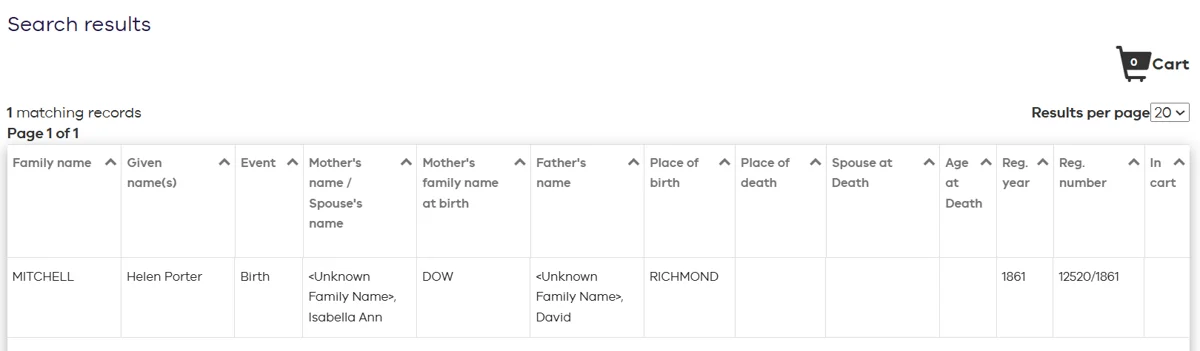
Everything matches the published biographies: Richmond, 1861, David and Isabella, and the Dow maiden name. With a common surname like Mitchell, the parents’ names and the place are how you know you have the right child.
One quirk to know: the parents’ columns show “<Unknown Family Name>” before their given names. That’s how the index displays them, not a missing record. The family name is the child’s, and the mother’s maiden name sits in its own column.
The same applies to your own family: nicknames, stage names and the names people used day to day often aren’t what was registered. Nellie is a pet form of Helen. Find the registered name first.
Trap 2: the marriage isn’t in Victoria
Your next step would normally be her marriage. Search the Victorian index for a Helen Mitchell marriage in the 1880s and the right one won’t be there. After her mother died in 1881, the family moved to Mackay in Queensland, and she married Charles Armstrong in Brisbane on 22 December 1882. That marriage is in the Queensland index, which is free to search too: see how to search Queensland BDM for free.
Trap 3: neither is the death
Melba died on 23 February 1931, in Sydney. She was buried at Lilydale in Victoria, but a death is registered where it happens, not where the person is buried. Her death is in the NSW index, under her married name, Armstrong.
So one Victorian’s life is spread across three states’ indexes, under two surnames. That’s normal. Families moved for work, for land, for gold and for marriage, and every move can hide an event in another state.
Going back a generation
Her parents’ names lead to the next search. David Mitchell and Isabella Dow married in 1857, which is in the Victorian index. A marriage certificate names both sets of parents, which takes the family back another generation, often to Scotland, England or Ireland.
Watch the 65 second walkthrough
Victoria before 1853
Victoria was part of New South Wales until 1851, known as the Port Phillip District, and civil registration didn’t start until 1853. For earlier events:
- Search the church baptisms, marriages and burials in the Victorian index, which run from 1836 to 1853.
- Check the NSW BDM index as well, since Port Phillip was part of NSW at the time.
- Many early settlers left no church record at all. For those, newspapers on Trove and shipping arrivals are the next stop.
If the Victorian BDM search doesn’t find the record
- Search the neighbouring states. Try NSW, South Australia and Queensland, especially for families near a border or in mining districts.
- Try spelling variants. Mitchell might be indexed as Mitchel; Dow as Dowe. Clerks wrote what they heard. See name changes and spelling variants for the seven ways names change.
- Search the registered name. Look for given names in a different order, or a first name the person never used.
- Check the date limits. A birth from 1926 or a marriage from 1966 may not be searchable yet.
- Search without a given name. Use the family name and a parent’s name to list all the children of one couple.
Frequently asked questions
Yes. Searching the historical index on the Births, Deaths and Marriages Victoria website is free and needs no account. Certificates and images cost a fee.
Births from 1853 to 100 years ago, marriages to 60 years ago and deaths to 30 years ago, plus church baptisms, marriages and burials from 1836 to 1853, and events at sea from 1853 to 1920.
It may have happened in another state. Victorians often married or died interstate, and events are registered where they happen, so search the NSW, Queensland and South Australian indexes too.
Victoria was part of NSW, as the Port Phillip District, until 1851, and civil registration began in 1853. Search the church records in the Victorian index, and check the NSW index as well.
Get new guides by email
Get the free 9-step brick wall checklist, plus a new Australian family history guide in your inbox whenever one is published. No spam, unsubscribe any time.
New to family history? Start your family tree in Australia. Related: How to search NSW BDM for free · How to read an old death certificate · All Births, Deaths & Marriages guides
Sources: Births, Deaths and Marriages Victoria: Search your family history · Public Record Office Victoria: Births, deaths and marriages · Australian Dictionary of Biography: Dame Nellie Melba · Reserve Bank of Australia: Dame Nellie Melba
Stuck on a name or a record? Tell me what you’ve already tried in the comments and I’ll point you to the next search.