
A convict ancestor is easier to trace than most people expect. Around 160,000 convicts were transported to Australia between 1788 and 1868, and millions of Australians descend from them. Most can be traced with free records, often from their trial in Britain or Ireland to their ticket of leave and freedom in the colony.
Convict records also hold some of the hardest dead ends in Australian family history: aliases, misspelt names, and records that simply didn’t survive. This guide walks through the search using Mary Reibey, the businesswoman on the $20 note, who arrived as a 15-year-old convict under a boy’s name.
Quick answer: Start with the free British Convict Transportation Registers database at the State Library of Queensland, which lists over 123,000 convicts with their ship, trial place and sentence. Then search the records of the colony they arrived in: the Museums of History NSW convict indexes for New South Wales, or Libraries Tasmania for Van Diemen’s Land. Search every alias and spelling.
Watch the 65-second walkthrough
First: when did your convict ancestor arrive?
Which records exist depends on where the convict was sent:
- New South Wales: 1788 to 1840, plus “exiles” sent to Moreton Bay in 1849 and 1850.
- Van Diemen’s Land (Tasmania): 1803 to 1853, at first via NSW and directly from 1812.
- Western Australia: 1850 to 1868, the last colony to receive convicts.
Family stories often say an ancestor was a convict when they weren’t, and the reverse. If the family arrived after 1842 and lived in NSW or Victoria, they were probably free immigrants: see how to find when your ancestor arrived instead.
Step 1: Search the registers for your convict ancestor
The State Library of Queensland’s British Convict Transportation Registers 1787–1867 database is free and covers more than 123,000 of the roughly 160,000 convicts sent to Australia. It’s searchable by name, ship or arrival date through the library’s One Search catalogue.
Each entry gives the convict’s name and any known aliases, the place of trial, the length of sentence, the ship and its departure date, and where it arrived. The ship and the place of trial are the two keys that unlock everything else.
The big gap: the registers mainly cover convicts tried in England and Scotland. Irish convicts are mostly missing. For them, search the Ireland-Australia Transportation database at the National Archives of Ireland.
Step 2: Search the colony’s records for your convict ancestor
New South Wales
Museums of History NSW (formerly State Archives NSW) has a free online convicts index with over 140,000 entries. It covers the documents that tracked a convict’s path to freedom:
- Tickets of leave (1810–1875): permission to work for themselves in a set district.
- Certificates of freedom (1823–1869): issued when a sentence was served. These can cross-reference aliases and name a spouse.
- Pardons, conditional or absolute.
- Ticket of leave passports (1835–1869), convict bank accounts and exemptions from government labour.
It also has a separate index to convicts’ applications to marry, which can name both partners and the ships they arrived on.
Tasmania
Tasmania’s convict records are the most detailed in Australia, and the Libraries Tasmania Names Index is free to search. If your convict went to Van Diemen’s Land, start there.
The worked example: convict ancestor Mary Reibey
Mary Reibey was born Molly Haydock in Bury, Lancashire, in 1777. Orphaned and raised by her grandmother, she ran away from service and was arrested for stealing a horse. When she was caught she was dressed as a boy and calling herself James Burrow. She was sentenced to seven years’ transportation and arrived in Sydney on the Royal Admiral in October 1792.
She married Thomas Reibey in 1794, was widowed in 1811 and became one of the colony’s most successful businesswomen. Her life is well documented. Her convict trail is not, and that’s what makes her a useful example.
Trap 1: your convict ancestor’s alias and spelling
Her entry in the Royal Admiral musters, held by Museums of History NSW, reads “Mary Haddock, alias James Burrows”. That’s two traps in one line. Her surname is misspelt as Haddock, and her alias appears as Burrows, where her biography has Burrow.
The misspelling goes back further than Sydney. Search the State Library of Queensland’s transportation registers for “Mary Haddock” and the first result is an index record from the British Home Office registers (HO 11): “Mary Haddock, one of 325 convicts transported on the Royal Admiral, May 1792.” The clerks in England wrote Haddock too, so a search for Haydock, her baptism name, can miss her in both countries.
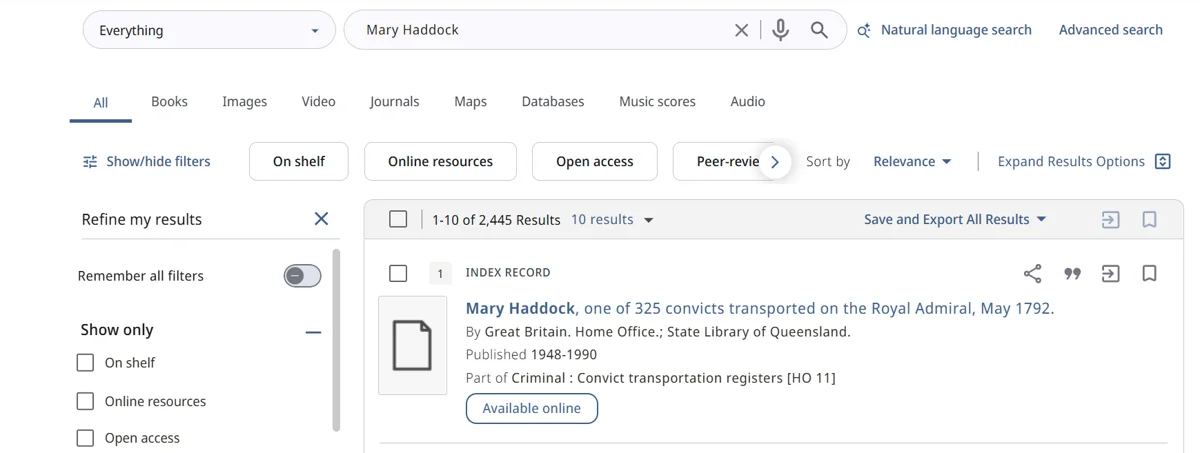
Note the date as well. May 1792 is when the Royal Admiral left England; she arrived in Sydney in October. The registers give departure dates, so don’t mistake them for arrival dates when you search the colony’s records.
And if a search returns thousands of results, as “Mary Haddock” does across the whole catalogue, look for the ones marked as index records from the convict transportation registers. Those are the convict entries.
Search “Mary Reibey” in convict records and you’ll find nothing about her as a convict, because she wasn’t Reibey until she married. Search “Haydock” and you may miss “Haddock”. Aliases were common among convicts, and the registers record them precisely because so many convicts used more than one name.
The fix: search the maiden name, every spelling you can think of, and any alias. Use wildcards where the database allows them.
Trap 2: the sources disagree
The Australian Dictionary of Biography says she was convicted at Stafford on 21 July 1790. The Royal Admiral muster says she was tried at the Stafford Assizes on 24 August 1791. Most modern accounts, including the Reserve Bank’s, put her arrest in August 1791.
Even a well-researched biography can disagree with the record. When dates conflict, go to the record made closest to the event, note both dates and where each came from, and look for a third source, such as the British trial records, before settling on one.
Trap 3: the records that don’t exist
Museums of History NSW notes that the muster entry is the only convict listing for Mary it could find. Her ticket of leave, pardon, assignment and permission to marry appear not to have survived, which is common for convicts who arrived in NSW before the 1830s.
If your early convict has almost no paperwork, that’s not a sign you have the wrong person. Turn to the records that tracked everyone in the colony instead.
Where she turns up instead: the musters
The colony held regular musters, a kind of early census. In the 1814 muster, Mary appears among the Sydney free women, listed under her maiden name, Haydock, with “Widow Reibey” in the last column. That one line confirms she was free by 1814, a widow, and still known officially by her birth surname twenty years after her marriage.
Musters and censuses from 1800 to 1825, and the 1828 NSW census, list convicts and free settlers together, often with their ship and status, such as “came free”, “ticket of leave” or “free by servitude”. They’re one of the best ways to follow an early convict.
If you still can’t find your convict ancestor
- Check they were a convict at all. Free settlers and assisted immigrants far outnumbered convicts after the 1830s.
- Try the Irish database if the family were Irish. The British registers largely leave them out.
- Search the musters and the 1828 census for early NSW convicts with no surviving paperwork.
- Look for a marriage. Convicts needed permission to marry, and the NSW BDM index covers church marriages from 1788.
- Search Trove. Newspapers printed lists of absconders, tickets of leave and court cases. See how to search Trove.
Frequently asked questions
Search the free British Convict Transportation Registers database at the State Library of Queensland, which lists over 123,000 convicts with their ship, trial place and sentence. Then search the convict records of the colony they arrived in.
Irish convicts are mostly missing from the British transportation registers. Search the Ireland-Australia Transportation database at the National Archives of Ireland instead.
Permission for a convict to work for themselves within a set district before their sentence ended. NSW tickets of leave from 1810 to 1875 are indexed free by Museums of History NSW.
Many records for convicts who arrived in NSW before the 1830s didn’t survive. Look for them in the colony’s musters and the 1828 census instead, and search every alias and spelling of the name.
Get new guides by email
Get the free 9-step brick wall checklist, plus a new Australian family history guide in your inbox whenever one is published. No spam, unsubscribe any time.
Related: How to find when your ancestor arrived · How to search NSW BDM for free · All Arrivals & Emigration guides
Sources: Museums of History NSW: Mary Reibey, convict and businesswoman · Museums of History NSW: Convicts index · State Library of Queensland: British convict transportation registers · Australian Dictionary of Biography: Mary Reibey · Reserve Bank of Australia: Mary Reibey
Stuck on a name or a record? Tell me what you’ve already tried in the comments and I’ll point you to the next search.