
If your ancestor died after the mid-1950s, Trove probably can’t help you find their death notice. Most of Trove’s digitised newspapers stop around 1955. The Ryerson Index fills that gap, and much more.
It’s a free, volunteer-built index to millions of Australian death notices, funeral notices and obituaries, from the Sydney Gazette of 1803 to papers published in the last week. This guide shows how to search it, and how to get from an index entry to the notice itself.
Quick answer: Search the free Ryerson Index at ryersonindex.org by surname, then narrow by given name and date. Each entry tells you which newspaper ran the notice and when. Then find that issue: on Trove for most papers before 1955, or through library newspaper archives and microfilm for later years.
What the Ryerson Index covers
- Millions of entries from hundreds of newspapers and other sources.
- Mostly death notices, plus many funeral notices, some obituaries and some probate notices.
- Strongest for New South Wales, including more than two million notices from the Sydney Morning Herald alone, with growing coverage of other states.
- Heavily modern: about half the entries are from the last 30 years, and since 2020 it has also indexed notices from funeral directors’ websites.
- Updated weekly.
It’s an index, not a collection of notices. It tells you where and when a notice was published; you then find the notice in the newspaper itself.
Why a death notice is worth finding
For deaths in the last 30 to 50 years, a death notice is often the easiest family record to get. Death certificates for recent deaths are restricted, but a published notice is public. It usually gives the date of death, the age, and a list of family members: spouse, children, their partners, and sometimes grandchildren. A funeral notice adds the church or chapel and the cemetery.
That list of names is how you find the living relatives who hold the photos, papers and stories, and how you work out which branch of a family you belong to.
Step-by-step: searching the Ryerson Index
- Go to ryersonindex.org and open the search page. It’s free, with no account.
- Enter the surname. Start broad: surname and a given name only.
- Add a date range if the name is common.
- Read through the results, using the age, the newspaper and any place details to pick the right person.
- Note the newspaper and the date of publication. That’s all you need to find the notice.
Apply everything from the name changes guide: married women appear under their married surname, and a notice may use the name the family knew them by rather than their registered name.
The worked example: Weary Dunlop
Sir Edward “Weary” Dunlop, the surgeon whose WWII service record we walked through in another guide, died in Melbourne on 2 July 1993. That’s well past Trove’s coverage, so it’s a job for Ryerson.
Search surname Dunlop, given name Edward, and the index returns 23 notices. The top of the list:
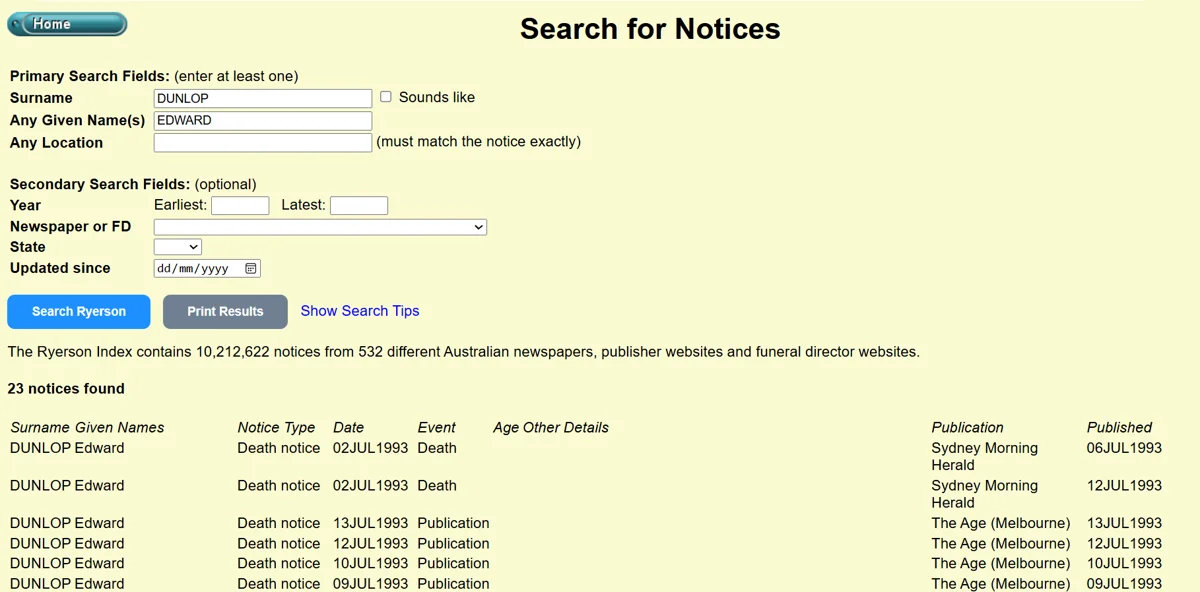
Here’s how to read it:
- The name is the everyday one. His official records give his first name as Ernest, but the notices call him Edward, the name he went by. A search for “Ernest Dunlop” is the one that would miss.
- The Event column matters. The two Sydney Morning Herald entries say “Death” with the date 2 July 1993: his date of death, taken from the notice. The Age entries say “Publication”: the date shown is only when that notice was printed.
- There are many notices, over many days. The Age ran notices on 9, 10, 12 and 13 July, and the Herald on 6 and 12 July. For a well-known person, notices are often placed separately by family, friends and organisations, and each one can name different people.
- He’s in the Sydney papers too. He lived and died in Melbourne, but notices ran in Sydney as well. Families often placed notices wherever relatives and friends lived, so search beyond the home state.
With the newspaper and date for each notice, finding the text is straightforward. For these 1993 notices, both the Sydney Morning Herald and Age ones are in the library newspaper archive listed below, free with a state or national library card.
Search options worth using
- Sounds like: tick this box beside the surname to catch spelling variants.
- Year, earliest and latest: narrow a common name to the right years.
- Newspaper or State: narrow to where the family lived, but only after a first, broad search.
- Any Location: must match the wording in the notice exactly, so leave it blank unless you know it.
From the Ryerson Index entry to the notice
Where you look depends on the date:
- Before about 1955: search Trove first. It holds full digital images of many papers to 1955, and some later, such as the Canberra Times to 1995. Browse to the date the index gives rather than searching, since Trove’s computer-read text often garbles names.
- 1955 to 1989, Sydney and Melbourne: the Google News Archive has many issues of the Sydney Morning Herald and The Age from these years, though not every issue.
- Sydney Morning Herald and The Age, to 2000: every issue is in the ProQuest Australian Historical Newspapers archive, free online through the State Library of NSW (with a NSW library card), the State Library Victoria and the National Library of Australia (with an NLA card). A few issues are missing or incomplete online; if the date you need won’t load, ask the library to check its microfilm.
- The last decade or so: online notice sites run by the newspaper groups, and the funeral director’s own website.
- Anything else: state and local libraries hold newspapers on microfilm. If you can’t visit, most state libraries offer an “Ask a Librarian” service; quote the newspaper and the date of publication from the Ryerson entry.
If you can’t find them in the Ryerson Index
- Check coverage. Ryerson is strongest for NSW and for recent decades. Coverage before 1900 is thin, around 220,000 entries for the whole of the 1800s.
- Try the married name, or the maiden name. Notices normally use the married name, sometimes with “née”.
- Try spelling variants and the given name the family used.
- Search the death first. If the death is old enough, the state BDM index confirms the date and place, so you know which week and which papers to look in.
- Not every notice is indexed. Volunteers add papers over time; a missing entry doesn’t mean there was no notice.
Frequently asked questions
Yes. It’s a free, volunteer-built index to millions of Australian death notices, funeral notices and obituaries, from 1803 to papers published in the last week.
No. It tells you which newspaper ran the notice and on what date. You then find the notice in that newspaper, on Trove, in a library archive or on microfilm.
Most of Trove’s newspapers stop around 1955. Find the notice in the Ryerson Index, then look up that newspaper and date through library newspaper archives, microfilm, or a state library’s Ask a Librarian service.
The date shown is when the notice was printed, not the date of death. Entries marked Death give the date of death taken from the notice.
Related: How to find family notices on Trove · How to read an old death certificate · All Newspapers & Trove guides
Sources: ryersonindex.org · the lookup page for finding a published notice · Trove · State Library of NSW: Australian Historical Newspapers 1831-2000
Stuck on a name or a record? Tell me what you’ve already tried in the comments and I’ll point you to the next search.