
When an ancestor seems to vanish from the records, the record is usually still there, hidden by name changes. It’s filed under a name you haven’t searched yet: a misspelling, a nickname, a maiden name, an alias, or a surname the family changed.
This guide pulls together the name traps from the worked examples on this site, all from real Australian records, and turns them into a checklist you can run on your own brick wall.
Quick answer: Before deciding a record doesn’t exist, search every version of the name: spelling variants, the registered name rather than the everyday one, maiden and married names, middle names used as surnames, and anglicised forms of foreign names. Then search without the given name, using a parent’s or spouse’s name to pick the right person out.
Watch the 65-second walkthrough
1. The clerk spelled it the way it sounded
Many of our ancestors couldn’t read or write, and the people filling in the forms wrote down what they heard. The same person can appear under several spellings in a single lifetime.
Real example: Mary Reibey was baptised Molly Haydock. The British convict register and her ship’s muster in Sydney both call her Haddock. Search only for Haydock and you can miss her on both sides of the world. See how to find a convict ancestor.
What to search: say the name aloud and write down every way it could be spelled. Watch for doubled or dropped letters (Mitchell, Mitchel), swapped vowels (Reibey, Reiby, Raiby), and silent letters added or lost.
2. Name changes: the family changed the surname
Migrants often anglicised their names, either on arrival or years later, to fit in, to be understood, or during wartime to sound less foreign.
Real example: Henry Lawson’s Norwegian father arrived as Niels Larsen. By the time Henry’s birth was registered in 1867, the family were Lawsons and Niels was Peter. Search the parents’ 1866 marriage under Lawson and you may find nothing; it was recorded before the change. See how to search NSW BDM.
What to search: the original form of the name, and records from before and after the change. German, Scandinavian, Irish and Eastern European surnames changed most often.
3. Deliberate name changes: a different name on purpose
People enlisted, worked or travelled under other names to escape a past, avoid being found, or get around a rule.
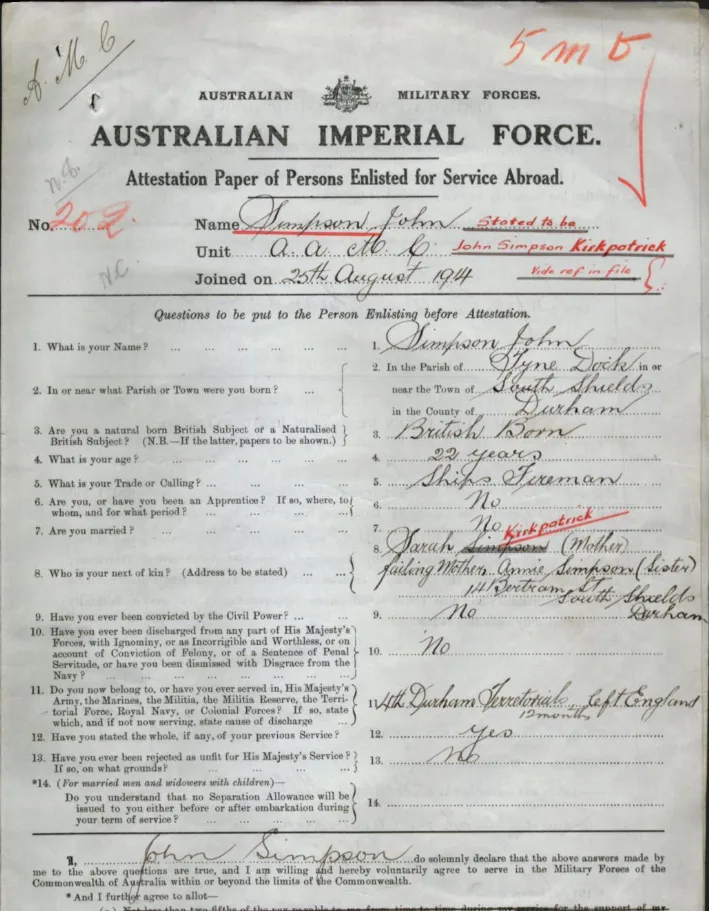
Real examples: John Simpson Kirkpatrick, the man with the donkey, deserted his ship in 1910 and enlisted in 1914 as plain John Simpson, his middle name. Mary Reibey was arrested dressed as a boy, calling herself James Burrows, and her convict record carries the alias. See how to find a WWI service record.
What to search: middle names used as surnames, the mother’s maiden name, a stepfather’s surname, and any “alias” or “stated to be” notes in records you’ve already found.
4. The name they used isn’t the name they were registered under
Family memory keeps the everyday name: the nickname, the stage name, the second given name someone actually went by. Official indexes keep the registered name.
Real example: Dame Nellie Melba’s birth is in the Victorian index as MITCHELL, Helen Porter. Melba was a stage name, and Nellie a pet form of Helen. The author Steele Rudd is the same: his 1868 birth is indexed under the name he was registered with, Arthur Davis. See how to search Victorian BDM and how to search Queensland BDM.
What to search: the formal version of nicknames (Nellie or Nell for Helen or Ellen, Bridie for Bridget, Jack for John, Bill for William, Polly or Molly for Mary), and given names in a different order. Someone known all their life as “Tom” may be registered as “William Thomas”.
5. Women changed surnames at marriage, sometimes more than once
A woman’s records split across her maiden name and every married name. Widows often remarried, and records can use either name depending on the date and the clerk.
Real examples: Melba married in Queensland as Mitchell and died in NSW as Armstrong. Mary Reibey married in 1794, but the 1814 Sydney muster still lists her under her maiden name, Haydock, with “Widow Reibey” beside it.
What to search: the maiden name for her birth, her marriage and any passenger list before her marriage; the married name for her children’s births and her death. In newspapers, also search her husband’s initials, as in “Mrs W. A. Smith”. See how to search Trove.
6. Name changes that are really index or scan errors
Even when the original record is correct, the index you’re searching was typed up later by someone reading old handwriting, or produced by a computer reading faded print. Handwritten letters are easy to confuse: a capital L and S, a lowercase u and n, an a and an o.
Example: in Trove’s computer-read text, “Lawson” can come out as “Lawsou” or “Lawsen”.
What to search: likely misreadings of the handwriting, wildcards where the database allows them (on Trove, Clark* finds Clark, Clarke and Clarkson), and, when you know the date, browsing the original pages instead of searching.
7. Prefixes and name changes came and went
Irish and Scottish prefixes are some of the least stable parts of a name. O’Brien can be indexed as O’Brien, OBrien, O Brien or just Brien. Mac and Mc were used interchangeably, and sometimes dropped.
What to search: each form separately, including the name without the prefix. Many indexes treat the apostrophe and the space differently, so “O’Brien” and “OBrien” can return different results.
The name changes brick wall checklist
Before deciding a record doesn’t exist, work through this list and note what you’ve tried:
- Write down every spelling of the surname you can think of, then say each aloud.
- Search the registered name, not the nickname, and try the given names in a different order.
- For women, search the maiden name and every married name.
- Search the middle name, the mother’s maiden name and any stepfather’s surname as surnames.
- For migrant families, search the original form of the surname.
- Try the name with and without Mc, Mac and O’.
- Search with no given name at all, and use a parent’s, spouse’s or child’s name to pick out the right person.
- Widen the date range, and check the neighbouring states.
- When you know the date, browse the original pages instead of searching the index.
Keep a note of every search you’ve run and what came back. When you return to a brick wall months later, you won’t repeat the same searches, and you’ll see the gaps.
Frequently asked questions
Often the record is there, filed under a name you haven’t searched: a misspelling, the registered rather than everyday name, a maiden or married name, an alias, or an anglicised surname.
Say the name aloud and list every way it could be written, including doubled or dropped letters and swapped vowels. Use wildcards where the database allows them, and a sounds-like option where one is offered.
Often. Many anglicised their surnames, on arrival or years later. Henry Lawson’s Norwegian father arrived as Niels Larsen and became Peter Lawson, so the family’s records sit under both names.
Her maiden name for her birth, her marriage and any passenger list before she married; her married name for her children’s births and her death. Newspapers often used her husband’s initials instead.
Get new guides by email
Get the free 9-step brick wall checklist, plus a new Australian family history guide in your inbox whenever one is published. No spam, unsubscribe any time.
Related: How to search NSW BDM for free · How to find a convict ancestor · How to find a WWI service record · All Brick Walls guides
Sources: Australian Dictionary of Biography: Henry Lawson · NAA: B2455, SIMPSON JOHN · Museums of History NSW: Mary Reibey · Australian Dictionary of Biography: Dame Nellie Melba · National Library of Australia: Newspapers for family history
Stuck on a name or a record? Tell me what you’ve already tried in the comments and I’ll point you to the next search.