
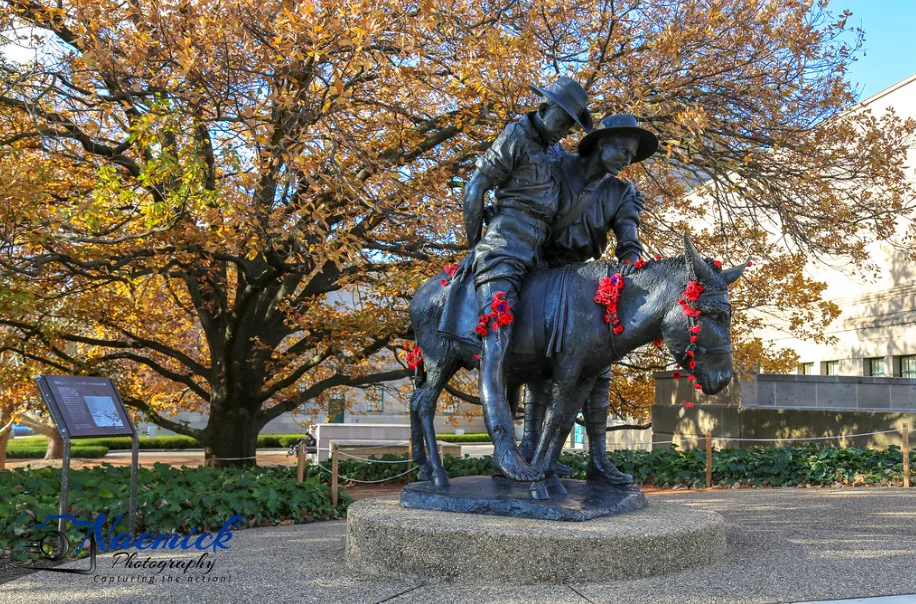
If your ancestor served in the Australian Imperial Force in the First World War, his service record is online, free, right now. The National Archives of Australia has digitised every WWI Army service record, and anyone can view and download them without an account.
Finding the right one is the hard part, especially with a common name. This guide walks through a real search using the file of John Simpson, the stretcher bearer famous as “the man with the donkey” at Gallipoli. His file teaches the biggest WWI dead end of all: he didn’t enlist under his real name.
Quick answer: Search the National Archives of Australia’s RecordSearch, using the NameSearch tab with the World War I category. AIF service records are in series B2455, and every one can be viewed free as a digital copy. If you can’t find your ancestor, try a middle name or his mother’s maiden name as the surname, because some men enlisted under another name.
What a WWI service record can tell you
Most WWI Army files contain three kinds of document:
- Attestation paper: filled in on enlisting. It gives age, place of birth, occupation, marital status, next of kin and a physical description, down to height, eye colour and scars.
- Service and casualty form (Form B103): his movements between units, promotions, and any wounds, illness or hospital stays.
- Correspondence: letters between the Department of Defence and his family about wounds, death, medals or his effects.
What they don’t contain is the story of the fighting. A file tells you where he was and what happened to him, not what he did there. WWI Army files also have no photograph.
Step-by-step: finding a WWI service record
- Go to the National Archives’ RecordSearch and choose to search as a guest. No account is needed.
- Open the NameSearch tab.
- Enter the family name. NameSearch matches the surname as typed, so check the spelling against his birth or marriage record.
- In Category of records, choose World War I.
- Run the search. For a common surname, add a given name to narrow it.
- Look for items in series B2455, the AIF personnel files. Click View digital copy to open the whole file.
To keep a copy, use the Export PDF icon in the digital copy window. It saves the whole file, rather than one page at a time.
Telling the right man from the wrong one
Search for “John Simpson” in the WWI records and you get a long list. Each item title follows the same pattern: name, service number, place of birth, place of enlistment, and next of kin. That’s how you pick your man without opening a single file.
Here are three of the John Simpsons on RecordSearch:
- Service number 1095, born in Dundee, Scotland, enlisted at Morphettville SA, next of kin his brother Albert
- Service number 6139, born in London, enlisted in Sydney, next of kin his wife Isabella Jane
- Service number 202, born in South Shields, England, enlisted at Blackboy Hill WA, next of kin his mother, Sarah Kirkpatrick
Match on what you already know, such as birthplace, the state he lived in, or a wife’s or parent’s name. Don’t rely on the service number alone. WWI numbers were allocated within units, so the same number was given to many different men.
The worked example: John Simpson, who wasn’t John Simpson
The third result is the man with the donkey. His file, NAA: B2455, SIMPSON JOHN, runs to 84 pages, and its title reads:
SIMPSON John : [AKA KIRKPATRICK John Simpson] : Service Number – 202 : Place of Birth – South Shields England : Place of Enlistment – Blackboy Hill WA : Next of Kin – (Mother) KIRKPATRICK Sarah
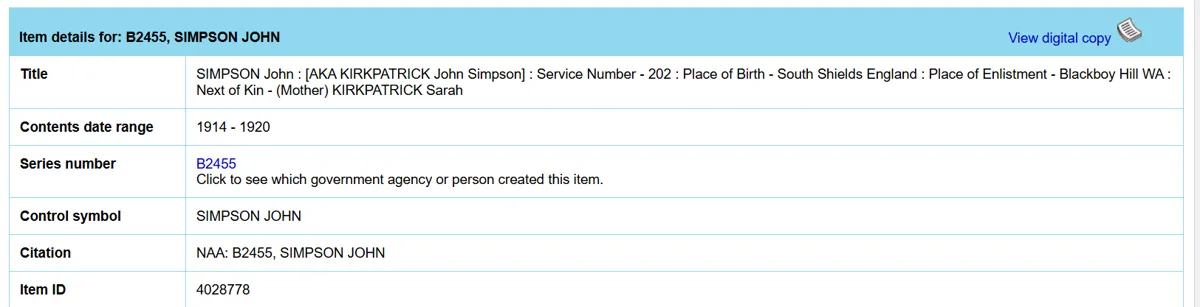
He was born John Simpson Kirkpatrick in South Shields in 1892. He came to Australia as a merchant seaman and deserted his ship in 1910. When he enlisted in Perth in August 1914, he dropped his surname and signed up as John Simpson, probably so his past as a deserter wouldn’t catch up with him. Simpson was his middle name, and his mother’s maiden name.
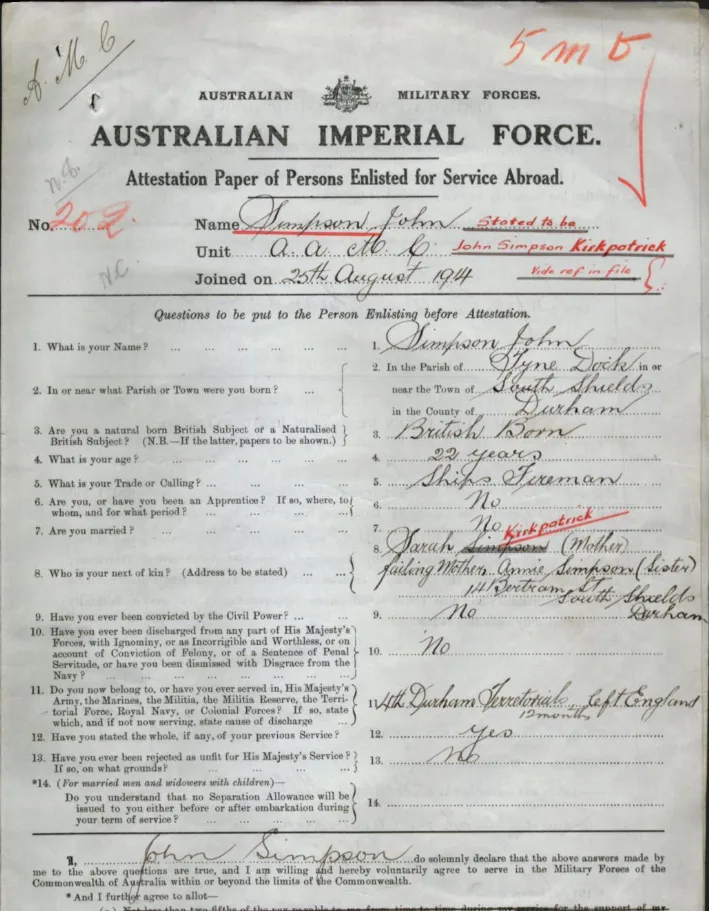
The first page of the file, his attestation paper, shows exactly how it happened. He signed as “Simpson John”, aged 22, a ship’s fireman born at Tyne Dock, South Shields. For next of kin he wrote “Sarah Simpson (Mother)”, and after her his sister Annie Simpson, both of 14 Bertram Street, South Shields.
Then look at the red ink. A clerk later struck through “Simpson” in his mother’s name and wrote “Kirkpatrick” above it, and added “Stated to be John Simpson Kirkpatrick” beside his own name. He had given his whole family his new surname, and the Army corrected the record later.
Watch the 65 second walkthrough
That red ink is the clue to look for in your own ancestor’s file. A corrected surname, an “alias” or “stated to be” note, or a next of kin with a different surname from the soldier can all mean he enlisted under another name.
Because he’s famous, archivists have added “AKA Kirkpatrick” to his file title. For most soldiers, nobody has. If your ancestor enlisted under another name, his file sits under that name and nothing links it to the one in your family tree.
Why soldiers enlisted under another name
- Escaping a past: desertion from a ship, debts, a marriage they’d left.
- Being under age: a boy might use an older brother’s details, or a false name so his parents couldn’t stop him.
- Being rejected once: some men turned down for medical reasons tried again elsewhere under another name.
- Sounding less German: men with German surnames sometimes anglicised them.
If your ancestor should have served but you can’t find him, search his middle name as a surname, his mother’s maiden name, and any stepfather’s surname. Then check the place of birth and next of kin in each result.
Check for a second WWI service record
The B2455 file isn’t always the only one. Search more widely and Simpson has another item: NAA: K1144, SIMPSON J, his pay ledger card. Small files like this can hold a detail the main record lacks, such as where his pay was sent.
Some B2455 items are just an empty envelope, with a note saying the contents were merged with the man’s WWII service record. If he served in both wars, his WWI papers may be inside his WWII file.
If you still can’t find his WWI service record
- Try other spellings. Search variants and anglicised forms of the surname, just as you would in the NSW BDM index. Our guide to name changes and spelling variants shows the common patterns.
- Search without the given name. Then scan the results for the right birthplace or next of kin.
- Check he served in the Army. B2455 also covers the Australian Flying Corps and the Army Nursing Service, but Navy service records are in a separate series.
- He may have enlisted but never gone overseas. Men discharged in training or who served only in Australia also have files.
- He may have served with another country. Many Australians were in Britain when war broke out and joined the British forces, whose records are held in the UK.
- Use the Australian War Memorial. Its embarkation and nominal rolls can confirm he served, and give a unit and service number to search with.
Frequently asked questions
Yes. Every Australian Army service record from the First World War, in series B2455, is digitised and free to view on the National Archives of Australia’s RecordSearch, with no account needed.
Usually an attestation paper with age, birthplace, occupation, next of kin and a physical description; a service and casualty form showing movements, promotions and wounds; and correspondence with the family. WWI Army files don’t include a photograph.
Some men enlisted under another name, so try a middle name, the mother’s maiden name or a stepfather’s surname. Also try spelling variants, and remember that some Australians in Britain joined the British forces.
No. WWI numbers were allocated within units, so the same number was given to many different men. Match on birthplace and next of kin rather than the number alone.
Get new guides by email
Get the free 9-step brick wall checklist, plus a new Australian family history guide in your inbox whenever one is published. No spam, unsubscribe any time.
New to family history? Start your family tree in Australia. Related: How to find a WWII service record · How to search NSW BDM for free · All military records guides
Sources: NAA: Army, First World War 1914-18 · NAA: Finding a service record · NAA: B2455, SIMPSON JOHN · NAA: K1144, SIMPSON J · Australian War Memorial: Private John Simpson
Stuck on a name or a record? Tell me what you’ve already tried in the comments and I’ll point you to the next search.